Monday, 13 August 2012

Exclamatory Paradise-Whydah

"Armchair tick" is a well-known term in birding circles, referring to a new species added to one's list as a result of a species being split by taxonomists into two species, or more generally to a bird identified well after the initial sighting.

The latter description applies in this case.  Browsing through bird books in the evening last week, I realised that I'd not seen Exclamatory Paradise-Whydah Vidua interjecta (yes, it is named thus because it looks like a flying exclamation mark!).  This species is very similar to the Eastern Paradise-Whydah Vidua paradisea, but lacks the clear cut golden-buff area on the hind-collar of that species.  The tail is also less tapering.  The females are subtly different as well.  V. paradisea parasitises Green-winged Pytilia and V. interjecta parasitises Red-winged Pytilia.  Since I have only seen Red-winged Pytilia east of the Nile, I concluded that some of the birds I'd seen on that side of the river might be Exclamatory Paradise-Whydahs.  Sure enough, looking through my photos I found several of a pair of Exclamatory Paradise-Whydahs.  The photos below show the differences between the two species.

Pair of Exclamatory Paradise-Whydahs, male showing chestnut nape with no well-defined golden-buff patch

Close up of female Exclamatory Paradise-Whydah showing head pattern lacking crescent markings behind eye

Male Eastern Paradise-Whydah in advanced moult into breeding plumage - note golden-buff nape absent in Exclamatory Paradise-Whydah

Full breeding plumage male Eastern Paradise-Whydah

Female Eastern Paradise-Whydah showing two dark crescents behind eye, absent in female Exclamatory Paradise-Whydah.

This experience serves to demonstrate the advantages of digital photography, enabling thousands of images to be taken and stored at no cost beyond the initial investment.

Jebel Kujur

On Saturday I climbed part of Jebel Kujur with Andrew and a Belgian colleague of his, Tina, who was visiting from the Karamoja region of Uganda.  This post predates the one below as Andrew had to email me some photos since I did not take my camera with its big telephoto lens in case it raised security concerns - though in the event I need not have worried, at least on our route.

I was looking for a partridge-type bird, perhaps Stone Partridge, that Laura had seen recently on the Jebel, as well as Cinnamon-breasted Rock Bunting, which Bram Piot (a birder who visits Juba from time to time) had seen.  A few minutes after starting our climb, Andrew pointed out a small bird a few metres away, and sure enough this was the bunting, the only one of the day.  The partridge eluded us, but at the summit we saw eight or so Red-winged Starlings, a classic bird of rocky hills in East Africa and yet another new Juba species for me. Down below there were plenty of Hooded Vultures, Pied Crows, Northern Red Bishops and some Bronze Mannekins but there were not many  birds higher up. We did see a Common Kestrel and a Wahlberg's Eagle, possibly a juvenile, near a large nest in a big tree near the summit.  As noted in the post below, Wahlberg's Eagle was not considered by Nikolaus to breed around Juba.

Wahlberg's Eagle

We saw a dozen or so Vervet Monkeys and a Rock Hyrax.  Andrew identified and photographed the butterflies, including Orange Tip Butterfly Colotis antevippe and the delighfully named Striped Policeman Coliades forestan.

Orange-tip Butterfly

Striped Policeman

Andrew also photographed this puffball fungus.

Puffball fungus

Sunday, 12 August 2012

Oxpecker and other Terekeka road birds

This morning, after heavy rain the night before, we went 20 kms up the Terekeka road (Lesley, Andrew, Bosco, Mark).  The first area of marshland was so flooded that the usual water birds seem to have abandoned it, thought intensive fishing may be a factor.  People were catching small catfish and we also saw a large Nile Perch for sale (about 8 kgs).  Appropriately, almost our first bird was an African Fish Eagle, an adult.

African Fish Eagle

The conditions were rather dull as it was completely overcast to start with, but it brightened later and birding improved throughout the morning.  An early find was a couple of Grosbeak Weavers, an uncommon species here.

Female Grosbeak Weaver

We found a male Vitelline Masked Weaver nest-building, whilst nearby a pair was attending a completed nest.


Male Vitelline Masked Weaver, starting to build a nest

Completed nest of Vitelline Masked Weaver

Next came a series of surprise finds.  A flock of White-billed Buffalo-Weavers was unusual, but even more so was finding a nest of this species attended by a displaying bird.  This bird is said to be a dry season wanderer to Juba.

White-billed Buffalo-Weaver, displaying below large nest

Displaying White-billed Buffalo-Weaver

Then we found two Northern White-crowned Shrikes, also regarded as a dry season wanderer to Juba, and my first here.

Northern White-crowned Shrike

Another unexpected bird was a Yellow-billed Oxpecker, again my first for the area.

Yellow-billed Oxpecker

This week, lots of indigobirds had arrived.  The males of these species are blackish and look almost identical; the best way to distinguish them is by voice: the males of the different species mimic the songs of the birds that they parasitise. The Village Indigobird Vidua chalybeata ultramarina, which I photographed, parasitises Red-billed Firefinch, which we also saw nearby.  This indigobird has red legs, unlike other local species, so is possible to identify more easily than the others; it also has purplish tones.  I photographed this species, and well as other birds that had paler legs.  The options for these seem to be Black-faced Firefinch Indigobird Vidua larvaticola, Cameroon Indigobird Vidua camerunensis, and/or Bar-breasted Firefinch Indigobird Vidua wilsoni.  Oddly, I've never seen any of the species parasitised by these species along the Terekeka road.  Cameroon Indigobird also parasitises Brown Twinspot, which should occur locally, but I've never found it.  A real mystery.

Village Indigobird (purple tones, red legs)

Unidentified male indigobird

We had good views of a male Bush Petronia, a rather retiring species that is not easy to find, and plenty of sightings of the beautiful Northern Carmine Bee-eater.

Male Bush Petronia


Northern Carmine Bee-eater

Overhead, we saw a few birds of prey including this adult White-headed Vulture.

White-headed Vulture

There was also a Wahlberg's Eagle, considered by Nikolaus (Birds of South Sudan) to be only a dry season visitor.   Finally, there were two Namaqua Doves, again considered a dry season visitor.

Namaqua Dove

Sunday, 5 August 2012

Just bats

I recently mentioned that I'd found some bats in my office compound.  Here are a couple of photos.  Any thoughts on identification would be most welcome.  They look like small fruit bats.  I'd never have seen them had I not been looking closely for nests of Village Weavers - none found and the weavers seem only to have been roosting in the trees. Village Weaver colonies in palm trees in Juba are very active and noisy now.


Small fruit bats?

There was a modest birdy end to the day: Andrew and I had a sundowner by a channel of the Nile at the Star hotel, seeing African Harrier-hawk, Red-necked Falcon, Long-crested Eagle, Pied Kingfisher, Common Sandpiper, Bruce's Green Pigeon among others.  We also heard what was almost certainly a Lesser Swamp Warbler.  An Ethiopian wedding provided a joyful endnote to the day.

Saturday, 4 August 2012

Nimule road

Birding proved quite a challenge this morning, with many birds being heard rather than seen. I went with Andrew and Lesley a short distance along the Nimule road, from where we turned off right, ending up by the Kit river, about 5 kms east of where it reaches the White Nile.

One highlight was the concentration of Black-winged Red Bishops, with many of the males now in full breeding plumage. There were far fewer Northern Red Bishops, much the commoner species north of Juba in wetter areas, and only one Black Bishop. Other good birds included Yellow-fronted Tinkerbird, Black-bellied Bustard, Levaillant's Cuckoo, Fawn-breasted Waxbill, Vitelline Masked Weaver, African Moustached Warbler, Tropical Boubou (heard only), Lesser Blue-eared Starling, Cardinal Quelea (only my second record for the Juba area), and Swallow-tailed Bee-eater. Cisticolas were very vocal and conspicuous: Rattling, Singing, Red-pate, Croaking, Foxy and Siffling.  The last-named is clearly quite common - now that I have got to know the song.

Remarkably, there were two more male White-winged Widowbirds - a new species for South Sudan I found last week about 15 kms away from today's sites.  There must be a reasonable chance that they are breeding.

Black-winged Red Bishops

Black-winged Red Bishops

Black-bellied Bustard

Flappet Lark

Levaillant's Cuckoo

Cardinal Quelea, male in breeding plumage

Cardinal Quelea, male in breeding plumage

Below, for comparison, is a photo of the very similar male Red-headed Quelea.  Note that the red does not come so far down onto the breast.  This species also has more extensive red on the back of the head.

Male Red-headed Quelea

There was another excellent mammal sighting today, with several small groups of monkeys.  Andrew identified these as Red Patas Monkeys.


Red Patas Monkeys

We saw very few birds of prey: one Bateleur and two Dark Chanting-Goshawks.  The usual Hooded Vultures were circling over Juba and there was a pair of Common Kestrels near Acacia Village.

Tuesday, 31 July 2012

Nightjars by day only

On Sunday 29 July Bosco, Richard Trewby, Andrew Harberd and myself went out along the Terekeka road, seeing a good cross-section of the local birds, such as Eastern Grey Plain-eater, Red-billed Hornbill, Red-fronted Barbet, Klaas's Cuckoo and the first Village Indigobirds I've encountered this rainy season.  Oddly, all the related parasitic species we found were in the same area and included Pin-tailed Whydahs and Eastern Paradise-Whydahs as well as Village Indigobird.  We saw the male Pin-tailed Whydah doing its remarkable dancing flight in front of the female.

Red-billed Hornbill
Displaying Pin-tailed Whydah

[Blogging ethics compels me to say the the photo immediately above was taken last rainy season.]

There were also two specials.  The best was a male Pennant-winged Nightjar flushed about three times (but evading my attempts to photograph it).  What an extraordinary bird, with its long extensions to the 2nd primary feathers.  The other was a singing Lesser Swamp Warbler, my first definite record.

The following evening Bosco and I looked for nightjars at dusk along the Nimule road.  It soon started to rain heavily and we gave up, but not before seeing an elegant African wild cat crossing the road in front of us. Again no photo, but so good to find another African mammal species (and the next day I found a roost of bats in trees in the office compound - will try to take some photos).

Saturday, 28 July 2012

A new species for South Sudan

In the damp overcast morning I went across the Nile and down the old Nimule road as far as Rejaf, perhaps 8 kms.  The dense grasses in the open acacia woodland and cultivation were once again full of seed-eating birds.  Amongst a flock of Black-winged and Northern Red Bishops, I noticed a flash of white on a long-tailed, largely black, bird.  This turned out to be a White-winged Widowbird Euplectes albonotatus of the subspecies eques, which Nikolaus (Birds of South Sudan) speculated could occur along the Uganda border, and a first record for South Sudan.

White-winged Widowbird, male in breeding plumage

A non-avian highlight was this mongoose, perhaps an egyptian mongoose.  It was not shy, at least of cars.

Egyptian(?) Mongoose

As last time I came along this route, there were Silverbirds with fledged young. I again found the remarkably non-descript Siffling Cisticola, though it actually rather easy to identify at the moment as it gives its distinctive song of descending notes from the tops of trees.

Siffling Cisticola

I'm at last sorting out the glossy starlings.  Individual species can look so different depending on the light conditions.  Today most were Lesser Blue-eared Starlings: smaller that Bronze-tailed, with shorter tails that never show any bronze hues, often rather dull yellow eyes, and a rather turquoise-blue head.

Lesser Blue-eared Starling

I managed to get very close to a White-browed Sparrow-Weaver and an African Moustached Warbler.

White-browed Sparrow-Weaver

African Moustached Warbler

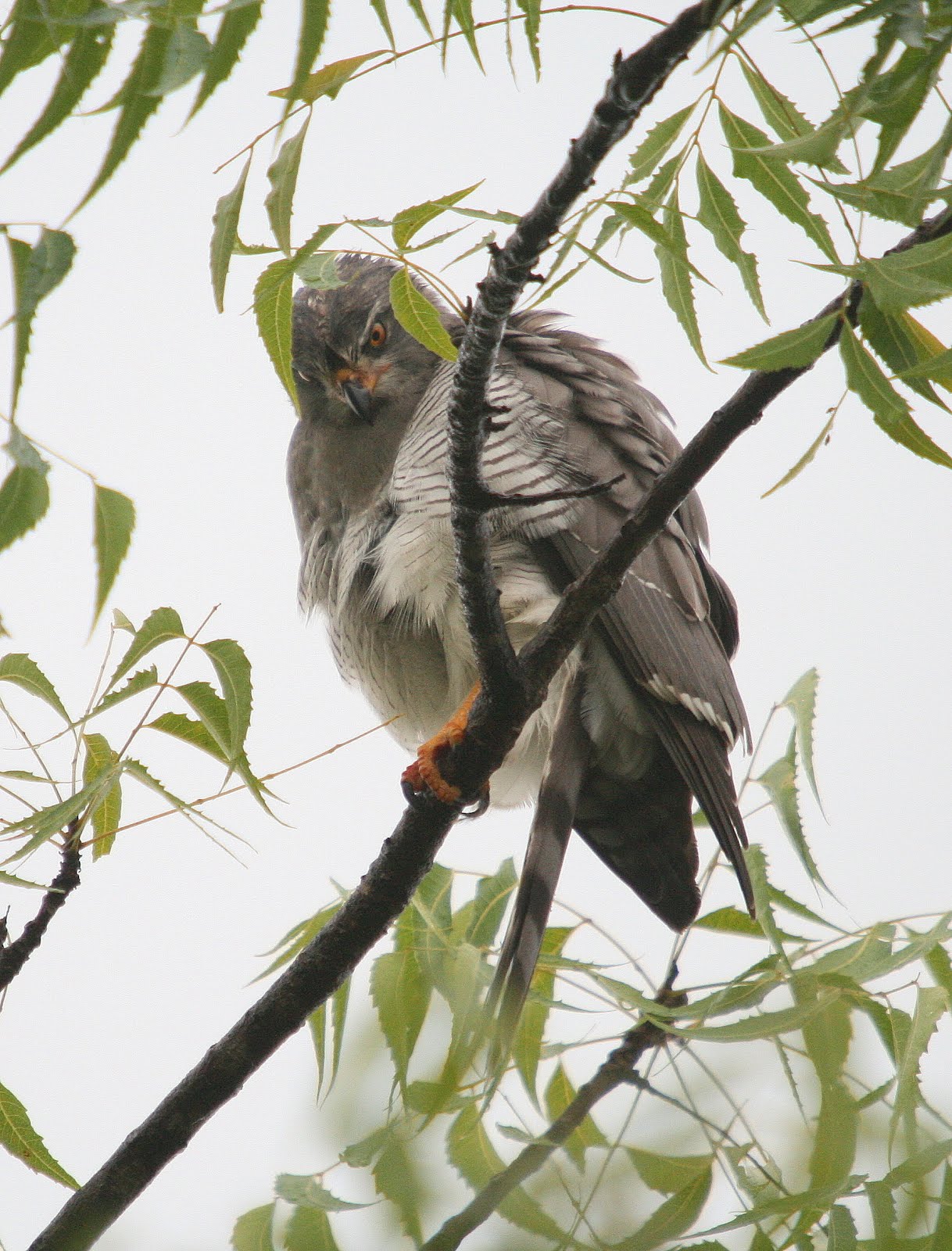
On the return journey a sub-adult Gabar Goshawk perched in a neem tree over the road and glared down at me.


Gabar Goshawk